The Icing on the Org Chart: Britain’s Office Cake Table and Its Unwritten Laws
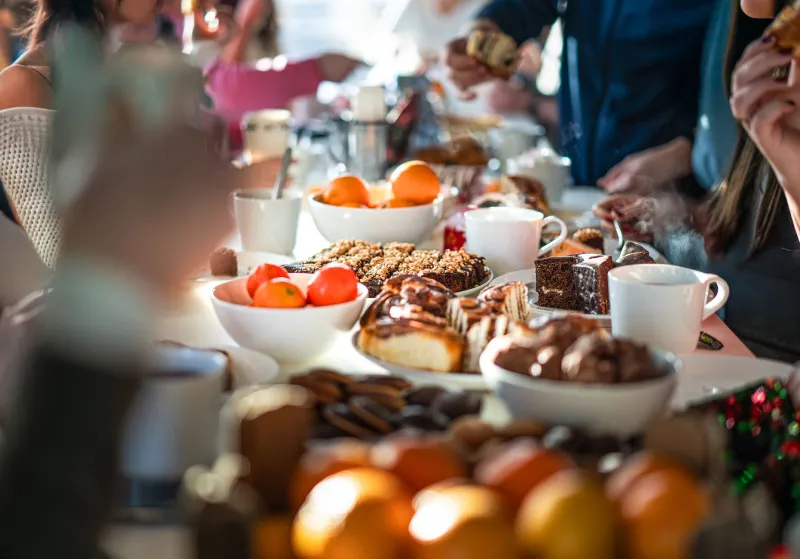
Somewhere between the printer that jams on principle and the meeting room named after a client who left years ago, Britain’s office cake table quietly runs the country. It has no constitution, no minutes and no elected chair. Yet everyone knows the rules. Bring a cake, become briefly beloved. Eat a cake, incur a debt. Leave your plate in the sink, become a case study in office justice.
The cake table is one of the last great British institutions that nobody has bothered to formalise. There is no onboarding module. No HR policy. No laminated flowchart. Just a Tupperware lid, a stack of napkins that never quite separates, and a faint sense that you are being watched by Linda from accounts.
The theatre of the small slice
It begins with the invitation. In a healthy office, it arrives by email with a subject line like ‘Cake in the kitchen!’ and at least one exclamation mark too many. In a less healthy office, it arrives as ‘Re: Re: Re: Team update — cake?’ and somehow feels like a warning.
Then comes the performance. ‘Oh, just a small slice,’ says the colleague who has been thinking about the cake since Tuesday. ‘I shouldn’t, really,’ says another, while hovering near the plate like a seagull with a mortgage. The knife hovers. The cake is assessed. Is it shop-bought? Is it homemade? Is it one of those supermarket creations that looks like a birthday card and tastes like refrigerated carpet?
A small slice is never just a small slice. It is a social contract. It says: I am participating, but I am not greedy. I am grateful, but I am not desperate. I am on a diet, but I am also a team player. In Britain, this is how we say ‘thank you’ without making eye contact for too long.
The flapjack fraud and other buffet crimes
The cake table has its own criminal code. At the top of the list is the colleague who brings supermarket flapjacks and calls them homemade. This is not a small offence. It is a breach of trust. The flapjack is placed on a plate, dusted with optimism and presented as evidence of domestic virtue. Everyone knows the truth. The packaging has been hidden in the bin like a murder weapon.
Then there is the person who brings a ‘healthy option’. A fruit platter at a cake occasion is like a salad at a barbecue: technically present, spiritually absent. There is the colleague who cuts the cake into forty-eight pieces so that nobody can accuse them of favouritism, and the one who cuts themselves a wedge the size of a hardback book and then says, ‘I’ll burn it off at spin.’
And let us not forget the passive-aggressive note. ‘Please remember this is a shared kitchen.’ ‘Please label your food.’ ‘Please do not leave crumbs on the counter.’ These notes are rarely about crumbs. They are about power. The cake table is where the office’s mildest grievances are baked into something sweeter and then served at room temperature.
The ledger of reciprocal sugar
Underneath the napkins, there is a ledger. It is not written down, but it is real. If you eat cake for someone’s birthday, you owe cake for yours. If you bring Krispy Kremes, you are a hero for a morning. If you bring a Colin the Caterpillar, you have made a statement. If you bring a Colin the Caterpillar and pretend you made it yourself, you have made a different statement, and HR may need to be informed.
The ledger is why the cake table is never really about cake. It is about fairness. It is about who remembered, who bothered, who contributed and who simply turned up with a fork. In an office where salaries are private, job titles are rigid and the temperature is controlled by a mysterious cabal, the cake table is one of the few places where everyone can be judged on roughly equal terms.
Except, of course, they cannot. Because the cost-of-living crisis has made the cake table awkward. A homemade loaf is cheap. A supermarket cake is not. A fancy bakery cake is a flex. The colleague who brings nothing may not be stingy; they may be skint. The colleague who brings a £30 celebration cake may not be generous; they may be trying to signal something to management. The cake table has become a quiet arena for money, status and the fear of being seen as the person who never chips in.
Hybrid work and the calendar invite of doom
Hybrid working has not killed the cake table. It has made it stranger. Now the invitation arrives as a calendar event with a Teams link, as if cake can be streamed. ‘For those in the office, there will be cake in the kitchen. For those at home, please join us on Teams.’ Join you for what? The sound of chewing? A live feed of a plate? A colleague saying, ‘Ooh, that’s a good one’ to nobody in particular?
In 2026, the office cake ritual is split between those who are physically present and those who are merely cc’d. The remote worker is expected to feel included, but not so included that they expect a slice to be posted to them. The office worker is expected to eat on behalf of the team, which is a noble duty and also a recipe for a mid-afternoon slump.
The passive-aggressive email has evolved accordingly. ‘Just a reminder that tomorrow is Priya’s birthday — cake in the kitchen at 3pm. No pressure to contribute, of course.’ No pressure is doing a lot of work in that sentence. It is the office equivalent of ‘I’m not angry, I’m just disappointed, and I have made a spreadsheet.’
Britain’s last functioning democracy?
So is the cake table the last truly democratic institution in Britain? In one sense, yes. Everyone gets a slice. Everyone gets a say in whether it is a good cake. Everyone can grumble about the person who brought the flapjacks. The cake table does not care about your job title. It cares about whether you remembered the napkins.
But a democracy needs transparency, and the cake table has none. The ledger is invisible. The rules are unwritten. The judgement is swift and the Tupperware is forever. It is less a democracy than a very polite tribunal with sprinkles.
Still, there is something worth defending. In a working world of hot-desking, muted microphones and managers who say ‘let’s take this offline’ before anyone has been online, the cake table remains stubbornly physical. It asks you to stand near another human being and say something that is not about deliverables. It makes you share. It makes you wait your turn. It makes you pretend you are not going to scrape the icing off the knife when nobody is looking.
That may not be democracy. But it is close enough for a Wednesday afternoon. And if you are the person who brings supermarket flapjacks and calls them homemade, we know. We have always known. The cake table remembers.