Objection, Your Honour: Britain’s Doorbells Have Gone Full Crown Court
There was a time, not so long ago, when a British street settled its disputes through a delicate system of curtains, sighs and passive-aggressive bin placement. Someone parked slightly over your drive. You raised an eyebrow. Someone’s parcel went missing. You assumed it was Evri, or fate, or both. Now? Now we have footage. We have timestamps. We have a motion alert at 14:07 and a WhatsApp group called ‘Number 14 & Friends’ that is about to sit as a special tribunal.
The video doorbell was sold to us as security. In practice, it has become something stranger: a permanent, door-mounted documentary crew for the least interesting street in Britain. It does not simply watch for intruders. It watches for evidence. And Britain, a nation that already loves a rule and a quietly held grudge, has taken to this like a duck to a puddle.
The new front door is a witness box
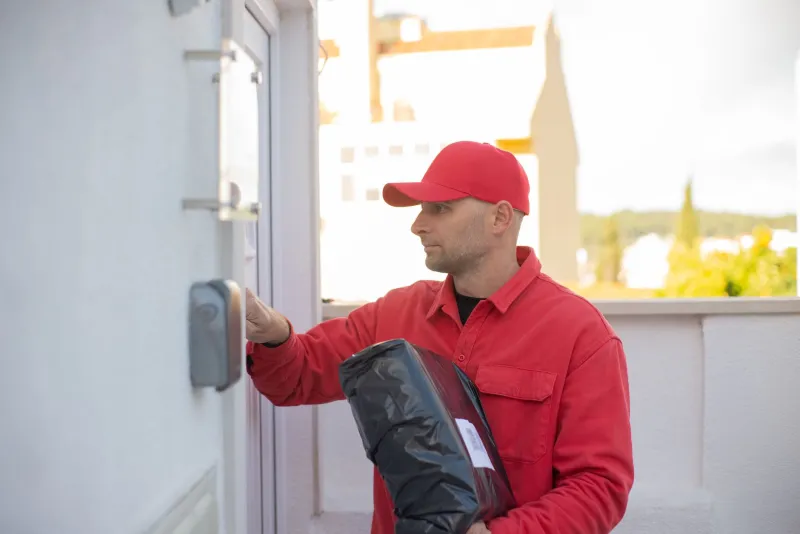
Walk down any suburban road in 2026 and you will see them: small rectangles of plastic, glowing like tiny judges. They are there to deter burglars, we say. They are also there to capture the courier who left a parcel in the ‘safe place’ marked ‘behind the bin’ — a location that, in Britain, is less a safe place and more a donation point.
The result is a new social ritual. Something goes mildly wrong. A parcel is tossed. A car idles for four minutes in a space that is not strictly anyone’s. A recycling caddy is moved six inches to the left. Within minutes, a clip is in the group chat. Within an hour, it has been reviewed, paused, rewound and discussed with the seriousness of a select committee. ‘Have a look at this,’ reads the message. ‘Not naming names, but…’
And then the names arrive. They always do.
The doorbell has turned neighbourly tolerance into amateur evidence-gathering. We are no longer a country of people who let things slide. We are a country of people who let things slide, then check the playback to confirm exactly how far they slid, then post it with a thinking-face emoji.
A nation of pavement prosecutors
It is not that the grievances are new. Parking has been a British blood sport since the first second car arrived. Bin day has always had the capacity to turn reasonable adults into boundary-obsessed cartographers. Parcel pilfering is genuinely annoying, and the courier who leaves a box of wine on full display has much to answer for.
What is new is the paperwork. The doorbell gives every minor irritation the shape of a case file. Exhibit A: the neighbour’s visitor, 11:42, blocking the dropped kerb. Exhibit B: the recycling bin, moved at dawn with what appears to be intent. Exhibit C: a courier doing a light jog away from the scene, which in the footage looks less like efficiency and more like guilt.
The language changes too. We do not say, ‘That was a bit annoying.’ We say, ‘I’ve got it on camera.’ We do not ask, ‘Could you move your car?’ We ask, ‘Did you see the playback?’ The doorbell has given us the vocabulary of the courtroom and the emotional register of a neighbourhood watch meeting that has accidentally become a Netflix true-crime series.
And because the footage lives in the group chat, there is no statute of limitations. A clip from Tuesday can be reopened on Friday. Someone will ask a question. Someone else will pause on a frame. A third person will say, ‘To be fair…’ — which, in British, is the opening statement of a prosecution.
What the camera misses
Here is the awkward bit: the doorbell is a terrible historian. It records the event, not the context. It sees a person move a bin. It does not see that the bin was blocking a pram, or that the person was helping, or that the whole thing was sorted out with a friendly word ten minutes later. It captures twelve seconds and invites us to write the rest of the story ourselves. And we do, usually with ourselves as the hero and the neighbour as a repeat offender.
It also misses the ordinary decency it cannot frame. The neighbour who takes in a parcel. The courier who actually knocks. The person who spots your cat in their garden and rings you rather than posting a blurry still with a caption about ‘irresponsible pet ownership’. The camera sees the doorstep, but it does not see the street.
There is a performance element too. Once you know the doorbell is there, you behave differently. You wave at it. You give a little thumbs-up as you wheel the bin out. You become a supporting artist in someone else’s surveillance footage. It is not quite Nineteen Eighty-Four, but it is close to a village pantomime with better resolution.
Better neighbours or better prosecutors?
There are real benefits. A doorbell can deter a thief, help find a missing delivery, or settle a genuine dispute without a shouting match. For vulnerable people, it can be a reassurance. Nobody is arguing that we should all go back to peering through net curtains and hoping for the best.
But there is a difference between security and scorekeeping. A camera can make us safer; it can also make us smaller. It can turn a street into a series of separate front doors, each one watching the others and filing the results. We might be better informed about who dropped what, when and where. We are not necessarily better neighbours.
The British compromise, as ever, is probably a quiet one. Keep the doorbell. Use it when it matters. But before you upload the clip, pause. Count to ten. Ask yourself whether this is a crime, a nuisance, or just a person existing slightly imperfectly on a Tuesday. If it is the last one, maybe let the group chat have a night off.
Because the doorbell may have a playback button, but neighbourliness does not. It only works live.