A Padlock and a Dream: Britain’s Sheds Have Gone Full Nation-State
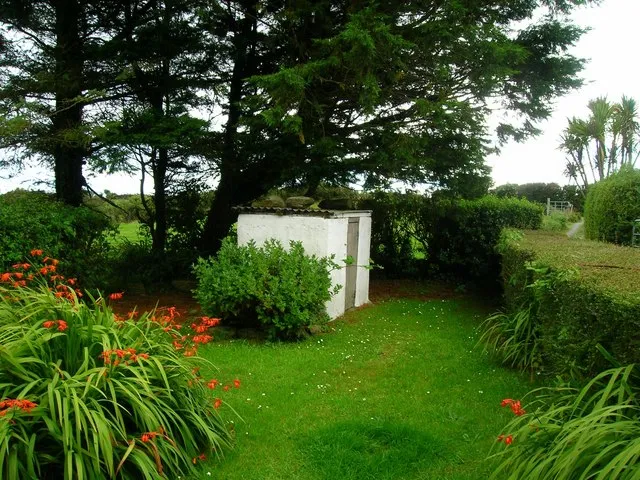
Photo: John Darch, CC BY-SA 2.0, via Wikimedia Commons
Every British garden contains a small, self-governing territory that has never signed a treaty, never joined a trade bloc, and has absolutely no intention of attending the residents’ association meeting. It is called the shed. Its borders are marked by a wonky path and a patch of grass that never quite recovers from the wheelbarrow. Its flag is a faded England one from a car window, or perhaps a laminated sign reading ‘Dad’s Shed — Keep Out’. Its currency is tea, and its foreign policy is a shrug.
The Doctrine of the Shed
The shed is not a building. It is a diplomatic position. The house may have a mortgage, a boiler that needs bleeding, and a fridge full of things that were once spring onions. The shed has none of that. The shed has a shelf. It has a stool. It has a radio permanently tuned to a station that plays either Test Match Special or a phone-in about potholes. It is, in short, the last room in Britain where nobody can ask you to do anything except hand them a screwdriver.
This is why the shed has become a kind of micro-nation. It has its own rules, its own rituals, and its own deeply unspoken hierarchy. It has citizens (the owner), honorary citizens (the neighbour who once helped carry a sheet of MDF), and undocumented visitors (the cat). It has a treasury (the biscuit tin) and a national archive (the jar of screws). It has a military capability (a can of WD-40) and a nuclear deterrent (the promise that you will one day sort out the wiring).
Come and Have a Look: The Sacred Invitation
No one enters a shed uninvited. This is not paranoia; it is protocol. The shed is a sovereign state, and sovereignty begins at the threshold. A knock on the shed door is not a knock. It is a request for diplomatic access. The owner will pause, look up from a task that may or may not be real, and utter the four words that open the borders: ‘Come and have a look.’
This is the shed’s greatest ritual. It is an invitation to stand in a slightly damp environment while someone explains why this particular drill bit is the one you want. You will nod. You will say ‘that’s handy’ about a tool you do not understand. You will be shown a shelf that was put up in 1998 and has not moved since. You will be told the story of the time the strimmer would not start, and how it was eventually fixed with a bit of wire and a firm word. You will not be offered a seat, because there is only one stool, and it is the owner’s.
Refuse the invitation at your peril. A shed owner who says ‘come and have a look’ and is met with ‘maybe later’ will remember it. It will be logged. It will be mentioned at Christmas.
The Padlock Parliament
The padlock is the shed’s constitution made manifest. It does not matter what the padlock is protecting. It could be a lawnmower, a bag of compost, or a bottle of something that was decanted in 2011 and has since become a family heirloom. The padlock is not about security. It is about sovereignty. It says: this far, and no further. It says: the house may have an Alexa, but the shed has a combination code.
The politics of padlocks are subtle. A combination lock suggests a modern, forward-thinking administration, possibly with a small notepad in the shed to remember the code. A key under the flowerpot suggests a more relaxed regime, one that believes in transparency and also in the fact that nobody is going to steal a half-used tube of mastic. A padlock that has seized up and no longer opens is not a failure. It is a strong border policy.
And then there is the inherited padlock. This is the shed equivalent of a crown. It came from a grandfather, or a previous house, or a car boot sale. The key has been lost since 2004. The shed has not been opened in months. The owner will still refer to it as ‘the shed’ and will still say ‘I’ll get it sorted’ in a tone that suggests it is a matter for the next government.
Inherited Tools and the Line of Succession
Every shed contains at least one tool that is older than the owner and considerably more stubborn. A drill with a cord that looks like it was rescued from a tumble dryer. A saw with a handle made of wood so dark it might be mahogany or might be something from the loft. A set of spanners that belonged to a man who knew a man who could fix anything, provided it was not electrical.
These tools are not used. They are venerated. They form a line of succession. You do not throw away a broken tool; you keep it because it once belonged to someone who kept it because it once belonged to someone else. The shed is not a workshop; it is a small museum of masculine continuity, with a kettle.
A Door That Shuts Properly
There is one thing the shed will never have, and that is a door that shuts properly. The shed door sticks, warps, swells in the rain, and requires a shoulder. It is not a fault. It is a feature. A door that shuts properly is a fantasy of the house, where everything is straight and the bins go out on the right day. A shed door that needs a firm nudge is a reminder that perfection is for show. The shed is for being left alone.
And that is the real point. The shed is not about DIY, although DIY happens in it. It is not about storage, although it stores things. It is about the quiet, profoundly British need for a door that shuts properly — or, more accurately, a door that shuts imperfectly, and behind which nobody can ask you to do anything. The shed is the last sovereign state. Its borders are a padlock. Its anthem is Radio 4. Its national dish is a Rich Tea. And its greatest export is the phrase ‘I’ll be out in a minute.’
Long may it stand. Or at least long may it lean slightly to the left and require a brick to keep the door open.