Scone, Save, Repeat: The Quiet Faith of the National Trust
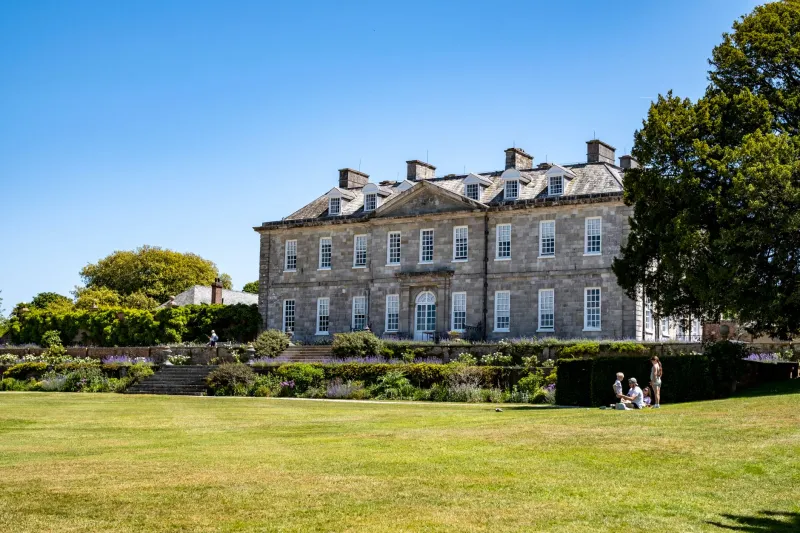
There are two ways to announce that you have reached a certain stage of British adulthood. The first is to buy a sensible waterproof coat. The second is to stand in a National Trust car park at 10:42 on a Sunday morning, reversing into a space with the solemnity of a bishop parking a mitre.
The National Trust is not technically a religion. It has no hymns, no creed and no hellfire sermons about the perils of impure thoughts. What it does have is a direct debit, a members’ handbook and an awful lot of wisteria. In modern Britain, that is close enough. If you want to know what we worship now, follow the queues for the tea room and look at what people are wearing on their lanyards.
The Direct Debit Conversion
Every faith needs a tithe, and the Trust’s is beautifully British: not demanded loudly, but suggested gently, preferably by a leaflet placed near a till. From roughly the price of a couple of flat whites a month, you too can become a member. You will receive a card, a map and the right to feel faintly superior in a car park in Wiltshire.
What is interesting is how quickly the card stops being a practical object and becomes a badge of identity. It sits in the wallet next to the gym membership you have forgotten about and the loyalty card for a coffee chain you no longer visit. But the Trust card is different. It says something about you. It says: I like old things, but not in a weird way. I enjoy nature, provided it has been signposted. I believe in preservation, parking and a decent slice of Victoria sponge.
Membership is not really about visiting. It is about belonging to a version of Britain where the hedges are trimmed, the signs are legible and the bins are tasteful. It is subscription-based patriotism. You are not just buying entry to a house; you are buying a small, annual share in the idea that we are a country that looks after things.
Pilgrimage Begins at the Car Park
The pilgrimage has its own rituals. First comes the arrival, which is never straightforward. There is the slow crawl past the entrance, the debate over whether the machine takes cards, and the moment of quiet panic when the barrier does not lift. Then comes the reversing. National Trust car parks are where Britain’s hidden reserve of spatial confidence is unleashed. People who cannot parallel park on their own street will reverse into a gravel bay with the calm precision of a tank commander.
Next comes the map. The map is not a navigation aid. It is a sacred text. It tells you that the house is a seven-minute walk away, that the gardens are a twelve-minute walk away, and that the tea room is, miraculously, only three minutes away. Every family gathers around it as if it contains the location of the Holy Grail, rather than the location of the second-best loo.
And then there are the volunteers. The volunteer at the gate is the verger of this faith: friendly, slightly formidable and in possession of more local knowledge than the entire internet. They will tell you that the house is lovely, but the walled garden is really the thing, and that if you are quick you can get a table before the coach party arrives. You obey. You always obey.
Communion, but Make It Scone
No religion survives on architecture alone. It needs communion, and the National Trust has perfected it. The scone is not merely a snack; it is a sacrament. It arrives on a plate with jam, cream and a small knife, and it immediately provokes the oldest theological dispute in Britain: which goes first?
This is not a trivial matter. It is a test of character. The Cornish method and the Devon method are treated with the seriousness of competing interpretations of scripture. Families have split over less. Friendships have cooled. Someone at the next table is always watching, judging your cream-to-jam ratio with the quiet disapproval of a medieval inquisitor.
The tea itself is important, too. It must be hot, strong and served in a pot that is slightly too small for the number of people at the table. There is a particular pleasure in sitting in a converted stable block, listening to the clink of crockery and the low hum of middle-class contentment, while outside a light drizzle falls on a herbaceous border. This is the Church of England with better catering.
The Gift Shop Is the Nave
After communion comes the collection. The gift shop is where the National Trust truly reveals its genius. It is not a shop in the ordinary sense. It is a nave, a treasury and a carefully curated argument for the existence of tasteful capitalism. You came for a walk. You leave with a jar of marmalade, a tea towel featuring a Georgian wallpaper pattern and a wooden toy that costs more than your electricity bill.
The genius is that none of it feels like shopping. It feels like supporting a good cause. The tea towel is not an impulse buy; it is a contribution to the preservation of British heritage. The scented candle is not a candle; it is a small act of cultural stewardship. The books about local ghosts and forgotten railways are not light reading; they are relics.
And yet, somehow, everyone emerges clutching a paper bag. The gift shop is the point at which the secular pilgrimage becomes an economic transaction, and nobody minds. We have come to worship beauty, order and a decent cup of tea. It is only polite to buy a souvenir.
A Church With Better Lighting
The National Trust works because it offers something that churches often struggle to offer in modern Britain: a low-demand, high-reward form of belonging. There is no sermon to sit through, no collection plate to fear and no requirement to believe anything in particular. You simply pay your money, park your car and wander around a beautiful garden until it is time for cake.
But it would be wrong to call it empty. People go to these places because they are tired. They are tired of screens, traffic and the general friction of modern life. A stately home with a gravel path and a well-kept lawn offers a temporary escape into a world where things are slower, quieter and slightly more expensive. It is not really history we are seeking. It is calm.
So yes, the National Trust has become Britain’s fastest-growing religion, or at least its most agreeable subscription. Its tithe is modest, its liturgy is delicious and its gift shop is always open. The only real heresy is putting the jam on first. And even then, we are told, there is forgiveness — provided you buy a scone to apologise.