The Last Sunny Seat: Inside Britain’s Pub Garden Planning Committee
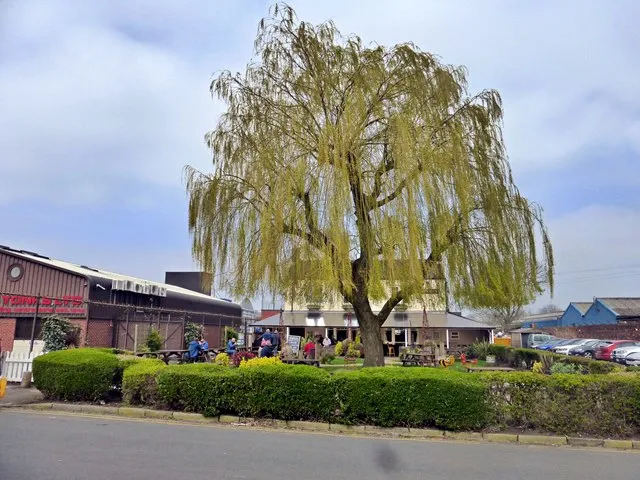
Photo: Graham Hogg , CC BY-SA 2.0, via Wikimedia Commons
There is a peculiar moment, somewhere between the first warm Saturday of the year and the first argument over a parasol, when a British pub garden stops being a garden and becomes a planning authority. Nobody announces it. Nobody prints a constitution. But by 2pm, the tables have been zoned, the shadow line has been negotiated, and a man in cargo shorts is standing near the hedge with the haunted look of someone who has just lost a boundary dispute to a family from Surrey.
We like to think of the pub garden as an easygoing place. A bit of grass, a few benches, a bag of Scampi Fries and a pint going warm in the sun. In reality, it is a miniature local council with worse seating and better cider. The rules are unwritten, fiercely observed, and enforced by a combination of passive-aggression, parasol repositioning and the silent adjudication of the phrase: “Is anyone sitting here?”
The Table Claim: Squatters’ Rights, But With Crisps
In pub garden law, possession is nine-tenths of the picnic bench. A table is claimed not by booking, nor by asking staff, but by the ancient ritual of placing something on it and walking away. A cardigan. A packet of crisps. A phone charger with no phone attached. A single pint that may or may not belong to someone who has nipped to the loo and may or may not ever return.
This is not a reservation system. It is a land registry written in lager rings. The item left behind must be modest enough to look accidental and valuable enough to discourage removal. A coat says “I am here.” A bag says “I am here and I have opinions about the sun.” A child’s sun hat says “We are here, we are organised, and we have already claimed the parasol.”
The experienced pub gardener knows the hierarchy. Front-row tables near the door are for the quick-draw merchants: the ones who arrive at 12:01 and secure the sun before the car park has filled. Tables near the swing set are a demilitarised zone, occupied by parents who have accepted that their pint will be drunk in three separate installments while someone hangs upside down. And the far corner, half in shade and half near the bins, is where the true veterans sit. They know the sun will move. They have brought a jumper.
Parasol Diplomacy and the Shadow Line
Nothing exposes the fragility of British civilisation like a parasol. In theory, it is a simple object: a canvas canopy designed to provide shade. In practice, it is a foreign policy instrument. Angling it one way can plunge a neighbouring table into gloom. Angling it another can roast a pensioner. The parasol is never neutral. It is either a shield, a weapon, or a passive-aggressive statement about whose comfort matters more.
There is a particular kind of pub garden standoff that occurs when the sun crosses the yard and the shadow line begins to creep towards a table of people who have been sitting in it for two hours. Someone will reach for the parasol crank. Someone else will say, with a smile that is 60 per cent teeth and 40 per cent threat, “Do you mind? We’re just in the sun.” The crank will stop. The shadow will advance. The matter will be settled by a silent agreement that nobody will mention again until the next round.
Warm lager diplomacy is the oil in this machine. A fresh pint offered across the border can cool a territorial dispute faster than any written policy. A bag of pork scratchings passed to the next table is essentially a trade agreement. And if someone’s dog wanders under your bench, you do not complain. You accept that the dog has diplomatic immunity and you move your crisps.
The Dog Zoning Question
Which brings us to dogs. In the pub garden, dogs are not pets. They are constituents. They have their own zones, their own water bowls, and their own complex system of social signalling. A dog under a table is a statement of belonging. A dog on a lead near the gate is a statement of intent. A dog weaving between benches with the confidence of a mid-level manager is a statement that this garden has always been his and the humans are merely tenants.
The unwritten code is clear enough: dogs are welcome, but they are not in charge of planning. A dog cannot claim a table. A dog cannot reserve a parasol. A dog can, however, create a temporary exclusion zone around a bowl of water, a dropped sausage roll and any patch of grass that looks like it might be softer than the rest. Humans adapt. Humans always adapt. That is how the garden survives.
The Glance: Britain’s Fastest Planning Inquiry
And then there is the glance. The “is anyone sitting here?” glance is the most efficient planning inquiry in the country. It takes less than a second. It involves eye contact, a slight tilt of the head towards the empty chair, and a raised eyebrow that carries the full weight of British social contract law.
The answer can be yes, no, maybe, or “my friend is just coming back from the bar and has been for twenty minutes.” The glance is not really a question. It is a request for permission wrapped in plausible deniability. It says: I am not challenging your claim; I am simply asking the court to clarify the boundaries. And the court, which is anyone already seated, will respond with a nod, a shake, or the dreaded half-shrug that means “I would rather you didn’t, but I am too polite to say so.”
Nobody elected these people. Nobody appointed the adjudicators. Yet the system works, mostly, because the alternative is a free-for-all in which the strongest, the loudest and the earliest get the sun while everyone else drinks in the shade and quietly seethes. The pub garden planning committee is not democratic. It is not transparent. But it is remarkably stable — as long as the parasol holds, the dog stays under the table and nobody mentions the shadow line until at least the second pint.
So next time you step into a pub garden and spot a free chair, pause. Look for the cardigan. Check the parasol. Respect the dog. And remember that you are not just finding a seat. You are entering a jurisdiction.